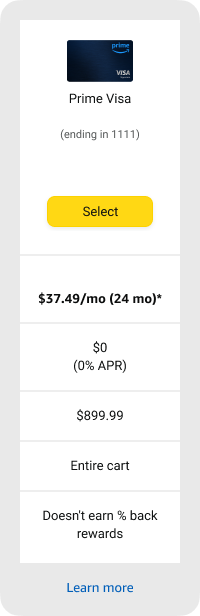
The visual states a plan card can take, a motion study of selecting and deselecting an offer, the provider art variants, and how the component's variant library is composed. Built on Material 3 color, type, and motion tokens.
surface, corner.large, elevation per state.title-medium / body-small.Pulled from the Stores Design Library — Generic button · Primary · Base. Amazon (RIO) uses discrete, token-driven fills per state rather than opacity layers:
Selecting an offer tints the surface to the primary container and lifts the card with elevation, while the CTA morphs from a filled Select into a pill-shaped Selected. Deselecting reverses it. Motion uses M3 emphasized easing with a spring on the CTA.
A live instance of the component — flipping a property re-renders it:
Show TT Text reveals each row's title label, Rewards / Applies to / Additional row
add or remove rows, Text link toggles “Learn more”, State restyles the surface & CTA,
Locale / Provider swap the currency format and card art, Theming switches light/dark mode,
and Platform shows how the same card renders inline on mobile vs. inside a dismissible modal
on desktop. One component, every combination — e.g.
State=Selected · Locale=Germany · Provider=Prime Visa · Theming=Dark.
State text and CTA labels meet WCAG AA against their surfaces; disabled uses the paired on-surface 38% / background-disabled tokens.
Selected is signalled by a border + label change, not hue alone — legible for color-blind users.
Full tab order with visible focus. Provider art is an arrow-key radiogroup using roving tabindex; switches are real role="switch" buttons.
Selection changes announce through an aria-live status region; every control is labeled (radiogroup, switches, selects).
Honors prefers-reduced-motion — section entrances and the select/deselect auto-play stop for users who opt out.
Copy localizes across 9 languages, currency & numerals format natively via Intl, and layout mirrors to RTL for right-to-left locales.
Conformance note: these reflect design decisions and intent. Full WCAG 2.1 AA conformance requires manual testing with assistive technologies (screen readers, switch access) and expert review.